
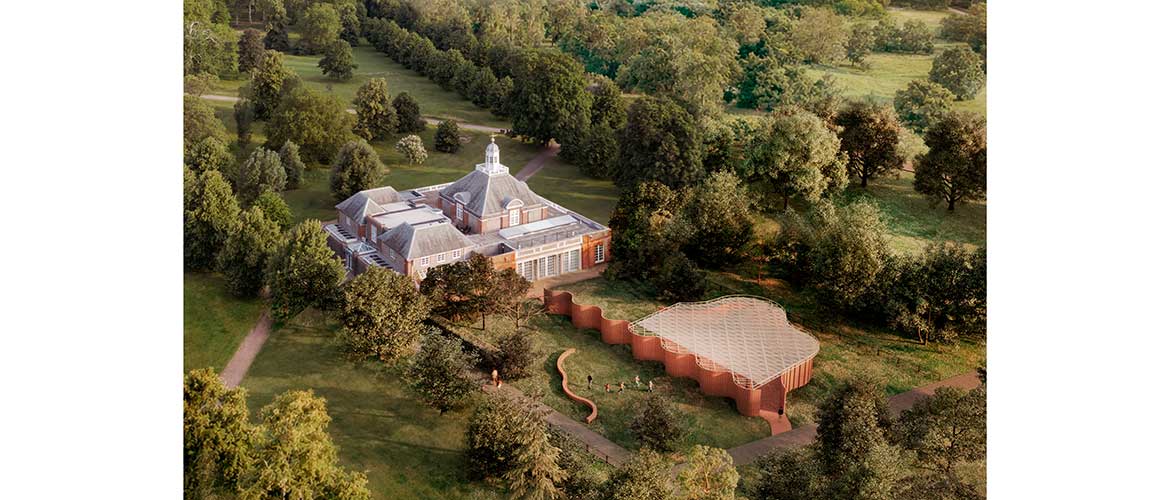
Serpentine is delighted to announce that the Mexican architecture studio LANZA atelier, founded by Isabel Abascal and Alessandro Arienzo, has been selected to design the 2026 Pavilion. Titled a serpentine, LANZA atelier’s Pavilion will be unveiled to the public at Serpentine South on 6 June 2026 with Goldman Sachs supporting the annual project for the 12th consecutive year. As the Pavilion reaches its 25th edition, Serpentine will celebrate this landmark anniversary through a special partnership with the Zaha Hadid Foundation.
Throughout its history, the Serpentine Pavilion has grown into a highly anticipated showcase for emerging talents. The Pavilion has evolved over the years as a participatory public and artistic platform for Serpentine’s experimental, interdisciplinary, community and education programmes.
LANZA atelier, founded in 2015 by Isabel Abascal and Alessandro Arienzo, is a Mexico City-based architecture studio. Their collaborative practice is rooted in the everyday and the informal, attentive to how technology, craft, and spatial intelligence emerge in unexpected conditions. Their work locates beauty in use, assembly, and encounter, proposing ways of building that foreground dialogue and collective experience.
The duo places particular emphasis on hands-on design methods such as drawing and model-making, treating them as active tools for thinking through material, form, and structure. Working globally, the studio understands architectural practice as one that moves fluidly across cultural spaces, residential projects, public infrastructure, and furniture design, through a critical and engaged perspective.
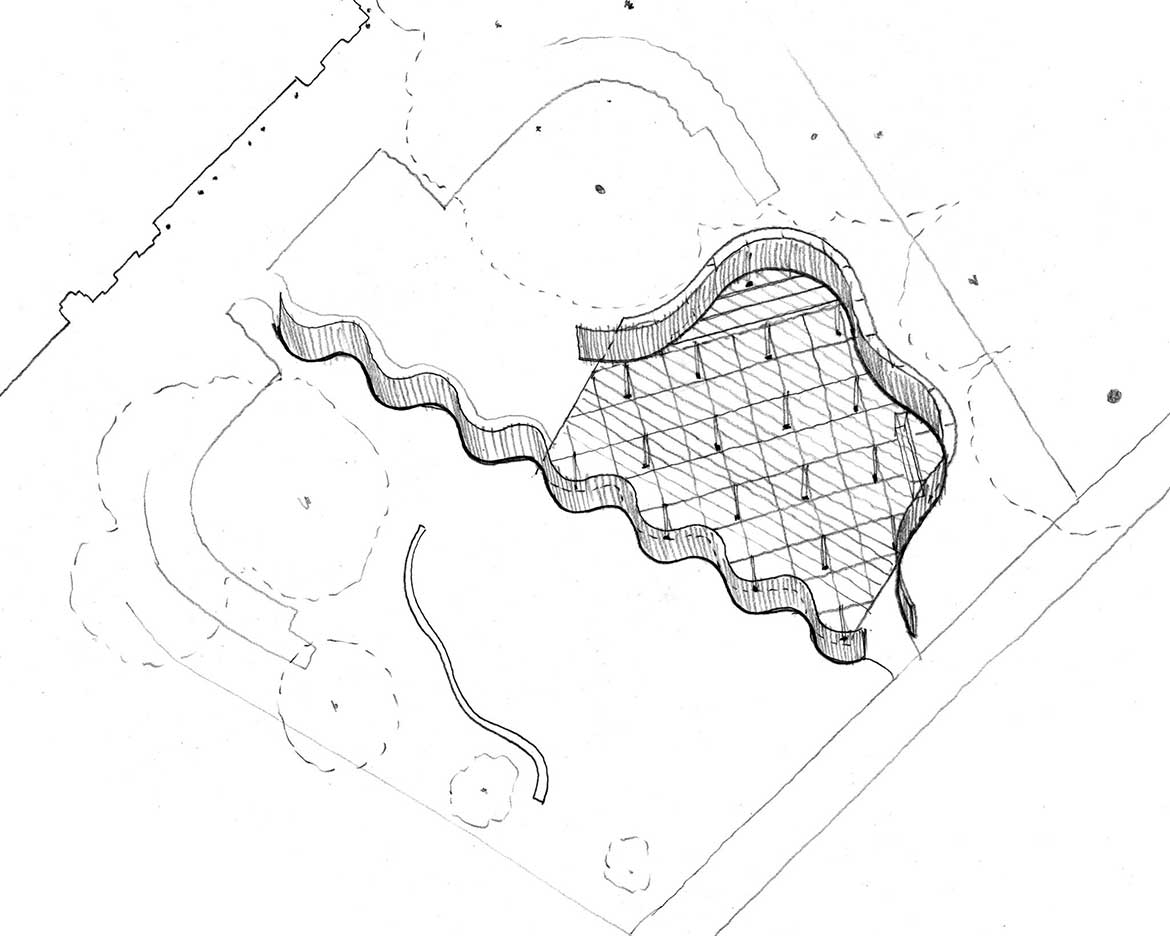
For this year’s Serpentine Pavilion, LANZA atelier took its inspiration from the English architecture feature known as a serpentine or crinkle-crankle wall which forms one side of the pavilion. This type of brick wall, composed of alternating curves, originated in ancient Egypt and was later introduced to England by Dutch engineers. Its curvilinear form provides stability through lateral support, meaning the one-brick-wide serpentine wall requires fewer bricks than a straight wall. The eponymous feature also subtly nods to the nearby Serpentine lake, named for its gentle curvature, evoking the form of a serpent.
In dialogue with the surrounding landscape, a second wall works in harmony with the tree canopy without disrupting it, while the main structure is positioned on the Northern side of the site. A translucent roof rests lightly on brick columns evoking a grove of trees. The pavilion’s configuration allows light and air to permeate the space, softening the boundary between enclosure and openness.
LANZA atelier chose brick as the primary material to celebrate the distinctly English garden tradition and establish a conversation with the existing brick façade of the Serpentine South Gallery, once a tea pavilion itself. Constructed from a rhythmic repetition of brick columns that transform the wall from opaque to permeable, the Pavilion becomes a metaphorical bridge between the geographies of Europe and the Americas.
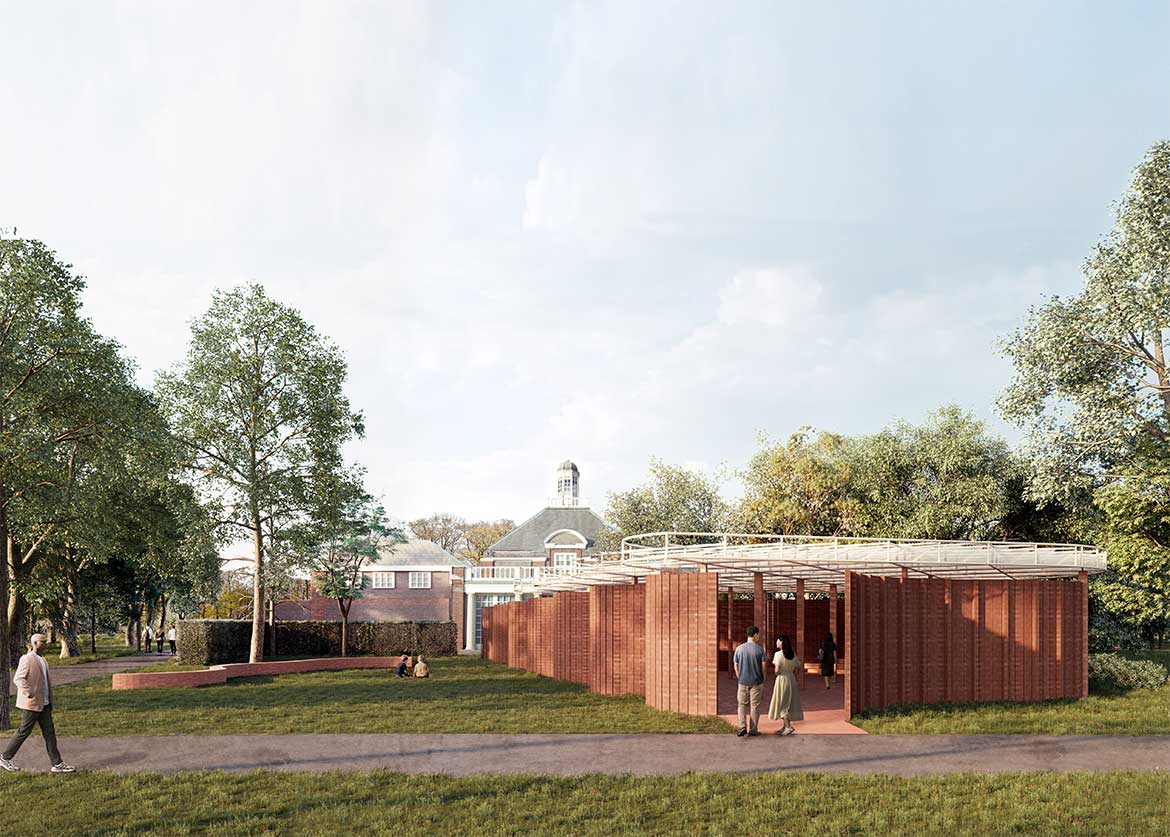
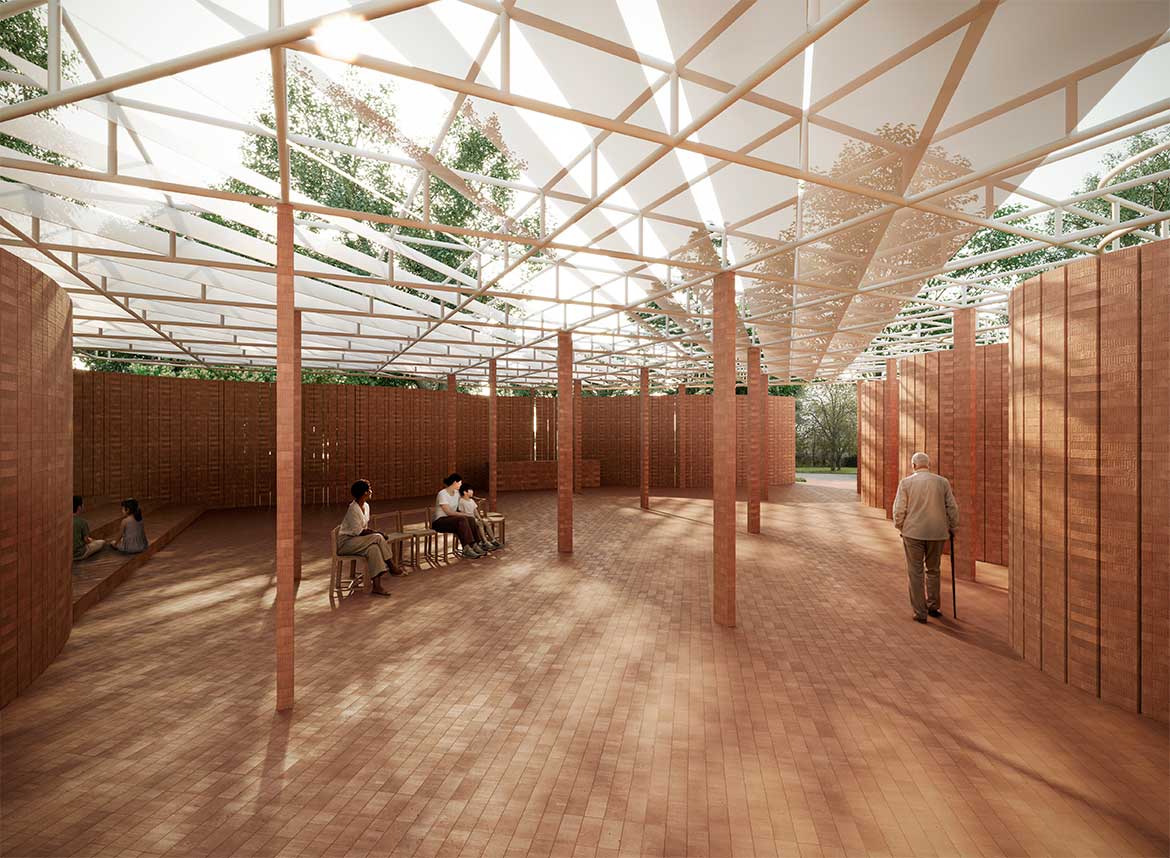
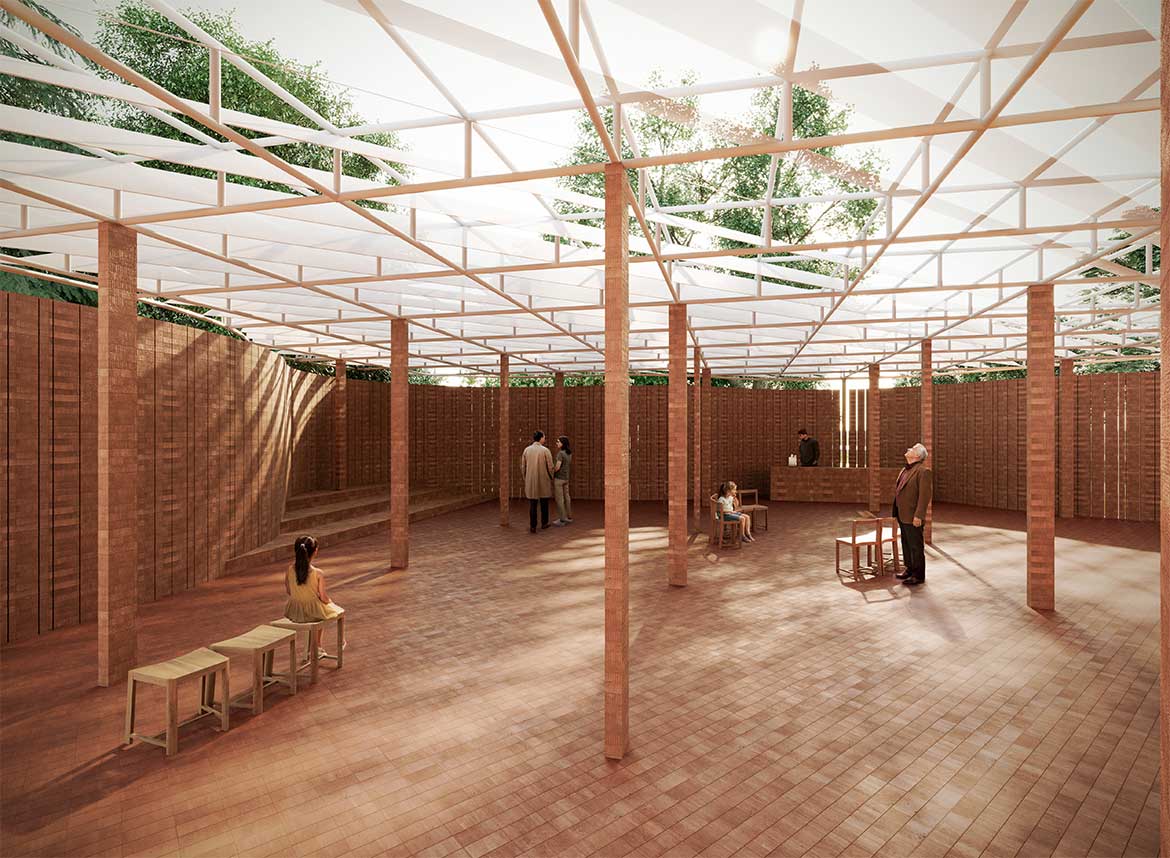
LANZA atelier said: “It is an honour to be selected as the architects of the 25th Serpentine Pavilion, a milestone year for the commission. We are deeply grateful for the opportunity to share our work with a wider public and to contribute to the Pavilion’s ongoing legacy of spatial experimentation and collective encounter. Set within a garden, an evocation of the natural world, the project takes the form of a serpentine wall, conceived as a device that both reveals and withholds: shaping movement, modulating rhythm, and framing thresholds of proximity, orientation, and pause.
Inspired by the figure of the serpent as a generative and protective force, we draw a parallel with England’s winding fruit walls, which are structures that temper climate, create shelter, and enable growth. From this idea emerges a pavilion built of simple clay brick, foregrounding vernacular craft and the elemental capacity of architecture to bring people together. The 2026 Pavilion proposes built forms that are permeable, shaped and held by a gentle geometry, and continually responsive to those who move through it.”
Bettina Korek, Chief Executive, Serpentine said: “For 25 years, the Serpentine Pavilion has been a leading global platform for architectural experimentation – first inviting internationally significant architects yet to build in London, and later championing emerging voices. It offers a rare brief: to test ambitious ideas in an open, accessible setting. Conceived as a structure that extends beyond its walls, the Pavilion connects architecture, landscape, and people. With LANZA atelier, we strengthen cultural exchange with Mexico and reaffirm the Pavilion as a free, civic space of connection, central to our summer and autumn programmes. We are deeply grateful to our partners and supporters for making the Pavilion possible.”
Hans Ulrich Obrist, Artistic Director, Serpentine said: “Over the last 10 years the Serpentine Pavilion has increasingly focussed on giving opportunities to younger architectural practices. We are excited to announce that Mexican architects LANZA atelier will design the 2026 Serpentine Pavilion. LANZA atelier’s architecture always involves a deep engagement with the local context, materials and lived experience. In their own words, they create contemporary spaces whose energy can last. Their spaces invite people to imagine a more connected, compassionate and creative future. As always, the Pavillion will be a content machine with lectures, film screenings and performances. We will also remember Zaha Hadid (1950-2016) who gave us our motto that «there should be no end to experimentation. As we mark the 25th Pavilion, we reflect on these origins. Since its inception in 2000, the Pavilion has acted as a catalyst for architects at pivotal moments in their careers. LANZA atelier’s Pavilion will mark the second time Mexican architects are appointed since Frida Escobedo in 2018. We are grateful to LANZA atelier for embracing this invitation, and we extend our sincere thanks to Sou Fujimoto for his generous guidance.”
Throughout the Summer and until October, the Serpentine Pavilion 2026 will become a platform for Serpentine’s live and events programme, providing encounters in music, film, theatre, dance, literature, philosophy, fashion and technology. Each year’s commission respond to the unique architecture of the Pavilion, inviting audiences to experience the activated space.
In 2026, Serpentine will collaborate with the Zaha Hadid Foundation to commemorate Zaha Hadid’s legacy and mark the 25th Serpentine Pavilion. A dedicated programme on architecture will take place at Serpentine South. As the architect of the inaugural Serpentine Pavilion in 2000, Hadid’s spirit of innovation has set the tone for what has since become one of the world’s most influential architectural commissions. This approach continues to shape not only the Pavilion series, but also Serpentine’s wider programme of exhibitions and live events.
The programme will aim to explore Hadid’s groundbreaking contributions to the field while connecting new and wider audiences with innovative architectural conversations. Bringing together leading architects, thinkers, and cultural practitioners, it will foster transnational and transgenerational architectural dialogue, inviting former Pavilion architects to explore questions at the forefront of architecture today, reflecting on Zaha Hadid’s career and the legacy of the Pavilion whilst looking ahead to the possibilities of the future.
This year’s Pavilion selection was made by Serpentine CEO Bettina Korek; Artistic Director Hans Ulrich Obrist; Director of Construction and Special Projects Julie Burnell; Exhibitions Curator Chris Bayley; Exhibitions Curator Tamsin Hong; and Assistant Exhibitions Curator Liz Stumpf, together with advisor Sou Fujimoto.
Serpentine will publish LANZA atelier’s first monograph to accompany the Pavilion. Designed by Estudio Herrera, it will bring together new and insightful contributions from the fields of architecture, art and poetry. Generously illustrated in colour, it also features an extensive conversation between LANZA atelier and Serpentine’s Artistic Director Hans Ulrich Obrist and an essay by José Esparza Chong Cuy.
The Pavilion is supported by Goldman Sachs.

Isabel Abascal and Alessandro Arienzo of LANZA atelier.
Photo: © Pia Riverola
LANZA atelier
Isabel Abascal and Alessandro Arienzo founded LANZA atelier in 2015 in Mexico City with the purpose of making meaningful contributions to the beauty of the world. Since then, they have been nominated for the 2016 Ibero-American Architecture Biennial Award and the Mies Crown Hall Award for Emerging Architects, MIT Chicago in 2016 and 2022, and for the Brick Award 2021. The studio is one of the winners of the Young Architects Prize 2017 and the Emerging Voices Award 2023 from the Architectural League of New York which described their multimodal work as one that “expresses an inventiveness, a sensitivity to context, and a compositional refinement that spans scales and forms.” Following LANZA atelier’s first solo show, New Work at SFMOMA in 2018, the atelier’s work has been exhibited at the 12th São Paulo Architecture Biennale (2019), the Lisbon Triennale (2019), the Concéntrico Festival in Spain (2021), and the Latin American Architecture Biennial (BAL) 2023. Additionally, they have presented their work at Syracuse University (2025), Yale University (2024), CU Denver (2024), UTSA (2023), Cal Poly Pomona as part of the VDL House Residency Program (2022), the Constructing Practice Symposium at Columbia University (2019), among others. LANZA atelier’s upcoming projects include a solo exhibition of their furniture designs at AGO Projects in Mexico City, set to open on 3 February 2026, as well as the design of the 61st Venice Art Biennale’s Pavilion of the Republic of Kosovo, curated by José Esparza Chong-Cuy and presenting a new commission by Brilant Milazimi titled Hard Teeth (Dhëmbë të Fortë).
Isabel Abascal studied architecture at the Universidad Politécnica de Madrid, Technische Universität Berlin and at Vastu Shilpa Foundation in Ahmedabad by B.V. Doshi. She was a design studio professor for six years at Escola da Cidade in São Paulo, Brazil. From 2015 to 2017, she was Executive Director of the LIGA platform in Mexico City, and co-edited the book “Exposed Architecture” published by Park Books. Her proposal “Mother Architecture: Shaping Birth” is a Harvard GSD 2023 Wheelwright Prize Finalist and her project “Investigaciones sobre creación y pro- creación” has been awarded the National Fund for the Arts Prize 2023.
Alessandro Arienzo studied architecture at the Universidad Iberoamericana in Mexico City. He explores the different possibilities within architectural practice by developing hand-drawing and publishing projects such as the Housetypes book series. In 2017, he was a recipient of the National Fund for the Arts Young Creators Prize. With this grant, he developed an investigation on the Security and Citizen Participation Modules network. The resulting work became part of SFMOMA’s permanent collection in 2018. Several of his designs have been showcased institutionally, including «A family of 4» which is part of the Denver Art Museum collection.
Serpentine Pavilion
This pioneering commission, which began in 2000 with Dame Zaha Hadid, has presented the first UK structures by some of the biggest names in international architecture. The Pavilion is realised with the support of technical advisors AECOM. Following the 2013 Pavilion designed by Sou Fujimoto, the commission grew into a highly anticipated showcase for emerging talents, from Sumayya Vally, Counterspace (South Africa), the youngest architect to be commissioned, and Frida Escobedo (Mexico) to Diébédo Francis Kéré (Burkina Faso) and Bjarke Ingels (Denmark). In more recent years, À table was designed by Lina Ghotmeh (France and Lebanon) in 2023, Minsuk Cho and his firm, Mass Studies (South Korea) designed Archipelagic Void in 2024 and 2025 featured Marina Tabassum (Bangladesh) and her firm, Marina Tabassum Architects’ A Capsule in Time. Occasionally, artists working at the crossroads of architecture and urban landscaping were nominated, including Theaster Gates (USA) who designed Black Chapel (2022). The Serpentine Pavilion 2012 was designed by Herzog & de Meuron and Ai Weiwei.
In 2021, the Pavilion programme evolved beyond its physical location for the first time and expanded with a series of Fragments placed across London. It also saw the launch of Support Structures for Support Structures, a fellowship programme initiated by Serpentine that supports up to ten artists and collectives working at the intersection of art, spatial politics, and community practice.
About Serpentine
Building new connections between artists and audiences, Serpentine presents pioneering contemporary art exhibitions and cultural events with a legacy that stretches back over half a century, from a wide range of emerging practitioners to the most internationally recognised artists, writers, scientists, thinkers, and cultural thought leaders of our time.
Based in London’s Kensington Gardens, across two sites, Serpentine North and Serpentine South, Serpentine features a year-round, free programme of exhibitions, architectural showcases, education, live events and technological activations, in the park and beyond the gallery walls.
Public art has emerged as a central strand of Serpentine’s programme. Major presentations include a collection of Eduardo Paolozzi’s sculptures (1987); Anish Kapoor’s Turning the World Upside Down (2010); Lee Ufan’s Relatum – Stage (2018–19); Christo and Jeanne-Claude’s London Mastaba in the Serpentine Lake (2018); I LOVE YOU EARTH by Yoko Ono (2021); Dominique Gonzalez-Foerster In remembrance of the coming alien (Alienor)(2022); Alexandra Daisy Ginsberg’s Pollinator Pathmaker (2022–ongoing); Gerhard Richter’s STRIP-TOWER (2024); Yayoi Kusama’s Pumpkin at the Round Pound (2024); and Esther Mahlangu’s mural Umuntu ngumuntu ngabantu (2024) and Giuseppe Penone’s Albero folgorato (Thunderstruck Tree), (2012) and Idee di pietra (Ideas of Stone), (2010 – 2024), in 2025.
Proud to maintain free access for all visitors, Serpentine also reaches an exceptionally broad audience and maintains a profound connection with its local community.
About Goldman Sachs Group, Inc.
Goldman Sachs is a leading global financial institution that delivers a broad range of financial services to a large and diversified client base that includes corporations, financial institutions, governments and individuals. Founded in 1869, the firm is headquartered in New York and maintains offices in all major financial centers around the world.
//
Información enviada por:
Serpentine press@serpentinegalleries.org
Fotos: Serpentine Pavilion 2026 a serpentine, designed by Isabel Abascal and Alessandro Arienzo, LANZA atelier. Design render, aerial view. © LANZA atelier. Courtesy Serpentine.